Music jams along North Carolina’s Bluegrass Trails

The Carolina foothills have long been a centre of musical innovation and cross-cultural fusion. In this area of gently rolling hills, music and dance hold a place in the traditions of the community.

Enter the community jam. We were fortunate enough to visit several – and there are literally dozens of regular musical get-togethers. We’ve written about the excellent Earl Scruggs Center in Shelby, NC – if you are ever in the area it is worth a detour and several hours of your time. We gained a whole new appreciation for banjos and bluegrass and were eager to seek out spots we could hear more local players. We were not disappointed.

Fletcher
Because we really needed to see how the magic of bluegrass rolls out, we stopped in the town of Fletcher where, on a Monday night, we caught the open jam at the Feed & Seed: “A Family Friendly Live Music Venue that doubles as a church.” And it works.

This barely renovated, century-old feed and seed warehouse is now a non-denominational storefront church lovingly overseen by Pastor Phillip Trees. On Friday and Saturday nights bluegrass bands take to the stage (there’s a waiting list) and dancers practice their traditional Appalachian clogging (aka: flatfooting). Monday nights the church provides a home for the open community jam.

What we found was an evening of people immersed in the music of their lives and sharing their love of playing with anyone who walks through the door. This all-ages, all-faiths, event brings out the best in everyone.

We counted no fewer than 10 banjos, at least as many guitars, a doghouse (bass) and a sprinkling of violins (“fiddles,” y’all), resonator guitars and mandolins. There was even – cue the hairy eyeball – an electric bass on the bandstand. The average age was – oh, 65-70 – and there must have been 25-30 jammers all awaiting their turn and at least as many in the audience, cracking up, singing along and generally soaking up the vibe.

Pastor Trees has bands for his weekend shows lined up to play on his excellently appointed stage and sound system (two 20th-century Altec Lansing Voice of the Theatre speakers). The sound is terrific: warm and surrounding but not loud. Can’t make it to the Feed & Seed for a Monday night jam? You can stream the evening on your home computer. The cameras get turned on, the musicians fire the link to their Facebook friends and within a minute people are tuning in from all over the world.

As Pastor Trees says: “We’re free-giving back to the community.”

Drexel
In the Drexel Barber Shop, we crowded around a cluster of older men cradling a banjo, a mandolin, a resonator guitar, a guitar and a bass. Carroll Anthony’s dad – who carried his guitar into war with General Patton’s 3rd army – started this jam in 1964 and some combination of players and singers has been gathering here weekly since.

“He started strumming his guitar between haircuts,” Anthony explained. “Well, the chief of police played a mandolin. He started coming in and he’d pick a little bit. He’d get a call and have to take off. So he finally started leaving his mandolin at the shop. Joe came in and started playing banjo with them and it progressed from there. Today there are 30-40-50 people every Saturday morning.”

“These guys just love it. I couldn’t pay ’em to come here,” he explained. “They just love doing it.”

The sign in the barbershop says Pickin’ & Trimmin’ and that’s exactly what happens. Herbert Lambert – an 87-year old Second World War veteran – sat hunched over his mandolin.

“You’ll think he’s asleep, tobacco juice be drippin’ out of his mouth,” someone whispered, “but he’ll play here all day and go somewhere else to play all night.” Lambert plays circles around men 30 years younger. The back room is decked out with bluegrass memorabilia, posters of Bill Monroe, tributes to musicians who have visited, retired instruments adorn the walls and a circle of chairs for audience members close to the wood stove. It’s not fancy. It’s authentic.

There is no routine, no order of songs: one person starts up a melody and everyone else jumps in, takes their turn soloing, and comps along to the end. Visitors are welcome to sit in, youngsters are encouraged, singers are appreciated. Any skill level is welcome, as are players of any age. Most people play two or three instruments – some very well – and the whole spirit is about having fun and sharing the experience of making music.

Brevard
We loved the small town of Brevard (and not just because the incredibly efficient, family-owned – 100 years and counting – Eldridge Motors repair shop replaced our failed alternator with almost no notice). The new town library is great (it’s where we get lots of work done), there’s a world-class music school in town (the Brevard Music Center) and the downtown is neat and tidy with lots of interesting shops, including O.P. Taylor’s toy shop with one of the largest Lego inventories ever. The forests and waterfalls around Brevard have been used for movie shoots, including the first instalment of The Hunger Games.

We headed for the Silvermont bluegrass jam, started 32 years ago by local Harley Raines, sitting on his front porch. Things have grown and on Thursday nights the musicians and audience members crowd into a side room at the Silvermont, a heritage home that is now a community centre for seniors.

They jam here for the same reasons as everywhere else: for the pure enjoyment of playing and to keep the mountain music traditions alive. It’s mainly bluegrass and old-time, gospel mixed with a little bit of country.

Marion
The regular Friday night jam in the small village of Marion is named after a longtime local musician: Woody’s Original Mountain Music. Doors open at 6 pm and the music starts an hour later. Admission is free. Bands sign to be in the lineup and the list is posted up front. No one ever knows how many bands will show.

People were as interested in who we were and where we were from as we were about their fierce protection of traditional Appalachian mountain music.

The jam opens with a short prayer, led by Pastor Collins. Before and after, his wife mans the dessert table – thick calorie-laden slices of pie and cake fly off the shelf at 50 cents apiece. The goal is to keep the whole evening affordable.

The town is small but this event draws a regular crowd. Seats were quickly filled and new chairs are hustled to the sides. All were accommodated. The music and good vibes flow freely.

More info: Blue Ridge Music Trails of North Carolina
Banjo + Shelby = Earl Scruggs

The banjo warrants a lot more respect than it generally gets. The place to learn this – if you doubt us – is the Earl Scruggs Center in Shelby, North Carolina. The instrument came to America in the holds of slave ships: like many other imports, it was taken up and embraced by the Irish/Scots settlers and remade into a distinctly American phenomenon. And of the many who have picked out a song there is no one with the stature of homeboy Earl Scruggs (1924-2012). This hardscrabble son of a sharecropper did for the banjo what Jimi Hendrix did for the electric guitar: he showed everyone what was possible.

Shelby is at the hub of the Blue Ridge Music Trails of North Carolina, which wind through the foothills of the state. This region produced more than its share of country, bluegrass, old-time and gospel music – and the fusing of these styles gave rise to a uniquely American sound and sensibility. Performed at the level of execution that Scruggs and someone like comedian Steve Martin achieve, it is nothing short of breathtaking to listen to. If your first impression of Earl Scruggs calls to mind the theme music of the Beverly Hillbillies, well, okay. Flatt and Scruggs have impressed themselves into popular music and culture forever.

But the three-finger rolling style that Scruggs innovated — “ten notes per second with a melody in the middle of it” — transformed that instrument and launched, with Bill Monroe, a style that finds a massive worldwide audience and paved the way for next generation innovators like Béla Fleck, the jazz banjo virtuoso.

The Earl Scruggs Center does justice to his music and history. Centred in downtown Shelby, it is a state of the art exhibition – complete with a banjo petting zoo – that brings you into Scruggs’ life, his art and his politics.

Your first encounter is with the instruments of his childhood, behind glass, where you see his fathers’ guitar and violin. Music, you discern, was their only form of entertainment growing up in the hill country around Shelby.

The Center tells this story in multiple interactive ways. You can strum an electronic banjo or guitar at a large interactive digital video table where you can also isolate individual tracks to hear them out of context from the music. You can review the history of early bluegrass – from the union of Bill Monroe and Earl Scruggs – and then trace the history of Earl through his opposition to the Vietnam War and his fusion of his cherished bluegrass with the rock music of his sons, in the Earl Scruggs Review, in the early 1970s. It’s fascinating and sobering and you come away with a whole new respect for the man and the music.

The coolest thing about Scruggs was that he carried the music he loved all his life into every change that came through his life – “chasing the light,” as he described it, never letting his fingers rest until he picked his last roll.

ALSO IN THE AREA:

  • The Don Gibson Theater is an intimate (400 seats), soft-seat concert and film venue. Don Gibson is best known for his country hit, I Can’t Stop Loving You, which has been recorded by more than 700 artists.
  • The local Alston Bridges BBQ serves pulled pork with a vinegar-based sauce (true North Carolina style), hushpuppies and their signature red slaw (ketchup is the secret addition).

Georgia’s rich music history: Athens and Augusta

Cool things come out of university towns. The critical mass of students questing for identity and meaning, the energy of artists looking to push their own – and your – boundaries, the enabling atmosphere of a major learning institution in an era of political and cultural ferment – this combination is likely to give rise to innovations some of which will proceed to transform far beyond the municipal boundaries of their city of origin. So it is with Athens, site of the University of Georgia at Athens (UGA) and home to at least two (so far) institutions of the 20th century’s music scene: The B-52s and R.E.M.

Athens seems like a cool place to live. It’s certainly a cool place to visit. The city seems to grow out of the university grounds – which are lovely, spacious and extravagant. It’s a big city on a human scale. Lots of funky coffee shops, restaurants and bistros, bars featuring live music, a couple of cool bookstores, comic stores and used vinyl and CD outlets (including the famous WUXTRY – Georgia’s oldest independently-owned record store – where the members of R.E.M. would congregate). These co-exist on pleasantly shaded streets with upper-end shoe, clothing and sunglasses shops making for a pleasant walking experience. We did a tour with Paul Butchart, a local historian who gives Walking Music Tours of Athens’ rich musical history. Like everywhere else, live music venues opened and closed and relocated and went under at a furious pace – but out of this at least two major institutions attained escape velocity and transformed a corner of popular music.

athensblog6

I did make a point, some years ago, of doing some serious listening to Michael Stipe, et al., – who emerged from various university courses at UGA to form R.E.M. These guys produced album after album of intelligent rock music. From their punk roots playing the dives and student bars in Athens, they grabbed a significant share of critical and popular appeal and rode it to its natural conclusion. When the band realized they had attained all there was to attain in pop stardom, they wound it up. What they left behind is a catalogue of excellent, insightful, danceable and thoughtful rock and roll music. Whatever the various members do next, they can be proud of R.E.M.’s legacy of music and politics.

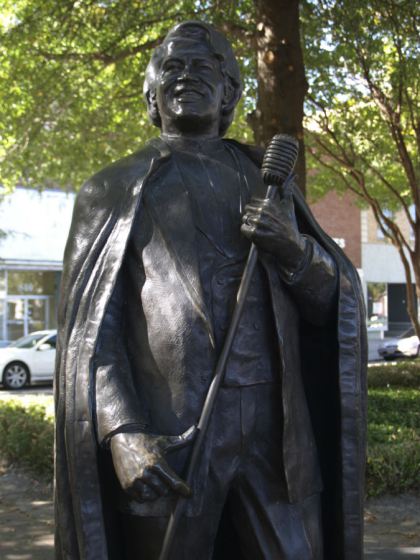
Augusta became the home of The Godfather of Soul, Mr. James Brown. Here’s a guy with a legacy to astound. Is there another figure from the 20th century who lived long enough to put his stamp on so many different styles of music? His legacy touches rock, blues, R&B, rap, hip-hop and, of course, soul.

Not bad for a former shoeshine boy from the streets of Augusta. His life size statue stands on the centre of the boulevard on downtown Broad Street.

athensblog3

Of course James Brown – they call him “Mr. Brown” in Augusta – showed promise very early. From there it was just a matter of turning talent into opportunity, but if Brown had anything other than talent it was vision: a crystalline conviction of what his sound and stage deportment was all about.

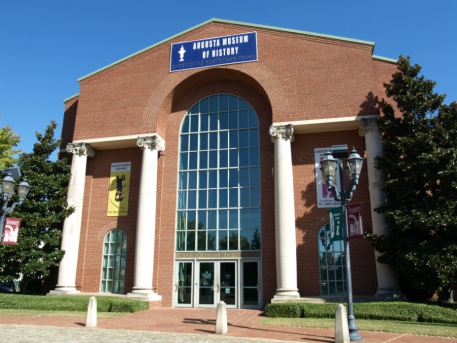
You can divine some of this at the Augusta Museum of History where they have curated a James Brown exhibit that takes you from his early youth to the final performance of his unnaturally long career. A few tidbits:

  • 95% of his stage suits and costumes were handmade.
  • He often played 300 shows a year.
  • He was the originator of “starting on the one.”
  • He was a self-taught musician with a love for gospel music.
  • He had perfect pitch.
  • He was a highly religious man.
  • He had a full hair salon in his home.
  • The dance moves he created circa 1968 were later copied by Michael Jackson and Justin Timberlake.

athensblog7

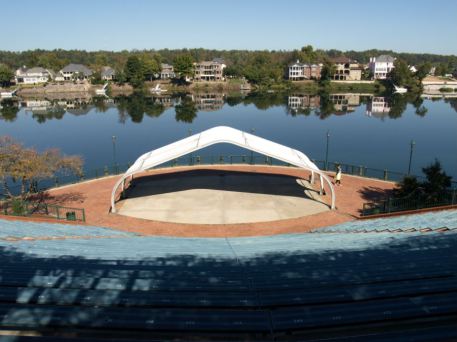
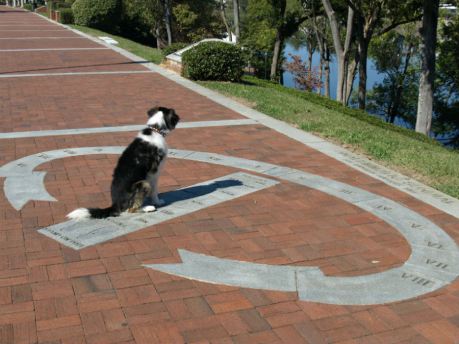
There’s lots more to see in Augusta too. This was – before the Civil War – a prosperous economic crossroads through which cotton and various other commodities passed en route to the ports of Savannah and Charleston. In the course of its economic development, wealthy families injected their fortunes into some pretty impressive – even by today’s standards – real estate and architecture. Well worth seeing. As is the lovely Riverwalk that features a perfect little amphitheatre looking over the river.

athensblog2

athensblog1

***

EATING & SLEEPING IN ATHENS: We stopped for lunch on the dog-friendly patio at Big City Bread Cafe for a delicious Turkey Burger with a side order of Bleu Cheese Fries (yes, house cut fries topped with blue cheese and served with garlic aioli and scallions).

athensblog5

We bypassed the campgrounds and stayed overnight at the dog-friendly, LEED Gold Certified Hotel Indigo, a short walk to the downtown Athens area. The service was great and the beds even better!

athensblog4

LOCAL LEGENDS FROM AUGUSTA:

  • Ty Cobb retired in Augusta
  • Bobby James brought Masters level golf to Augusta
  • James Brown, Oliver Hardy, Butterfly McQueen, Laurence Fishburne and Brenda Lee are all from Augusta.

WATCH THE THEATRE: The film Get On Up (2014) is about the life of Mr. James Brown.

Macon: “Something in the water”

Travelling from north to south our focus was on sticking as close to the coastline as possible and experiencing everything that is unique about where salt water meets land – from shrimp boats to lighthouses to incredible stretches of wild beach.

Once we hit the borderline at Georgia-Florida, we bounced back northward, but on the return trip we headed inland, looking for music destinations and regional food highlights. Boy, did we ever find a goldmine at the small city of Macon, Georgia!

There’s a word for it: SYNERGY. It’s that magic moment when – for reasons no one fully understands – the total is greater than the sum of its parts. This happens all the time, but occasionally breaks out with transformative impact. Macon is one of those places where – at a particular moment – big things happened because the stars aligned.

It brings to mind the establishment of Capricorn Records in 1969 and the recording of the first Allman Brothers Band album. Although not a commercial success at the time, the record has since come to be seen, in the words of one critic, as “the best debut album ever delivered by an American blues band, a bold, powerful, hard-edged, soulful essay in electric blues with a native Southern ambience.” More to the point, the record put Macon on the map as the preferred destination for what would come to the called Southern Rock.

Craig savoured the displays at The Big House, a lovingly curated collection of thousands of articles – instruments, clothing, hand-written lyrics, posters, tickets and rooms of furnishings. The Big House is the spiritual and actual home of the original Allman Brothers Band – the members lived and worked from here communally in the early 1970s. It is now a museum of all things ABB.

But Macon has other claims to boast too: it’s the city that birthed Little Richard and Otis Redding. This is an incredible amount of world-class talent for such a small city (population: 90,000). The locals like to joke that “it must be something in the water.”

Of Otis Redding there is much to say. He died at the peak of his considerable power, age 26, when his plane went down en route to a gig. But the 300 songs in his catalogue and the stamp he put onto R&B and soul music have long out-lived him. It’s ironic that his best-known song – (Sittin’ On) The Dock Of The Bay – is so unlike most of the other songs in his catalogue, and that he never got to perform it. The plane crash that took his life was a mere three days after he recorded the piece. It was his biggest hit and his first million seller. But you have to see a performance, perhaps from his tour of the United Kingdom, of Try A Little Tenderness so see how this man could bring an audience to frenzy.

We had the chance to sit down with Redding’s daughter, Karla Redding, who reminisced about her dad. “My favourite piece is Love Man,” she said. “Because it’s a pure description of the man he was.” Karla spoke of his commitment to family first and foremost and his obsession with ice cream (especially butter pecan). After we left the Otis Redding Foundation and Mini-Museum we went to the waterfront to see the statue of Redding.

“Little Richard,” Wayne Penniman, is authoritatively one of the founders of rock ’n’ roll. In his induction to the Rock and Roll Hall of Fame, Ringo Starr jokingly blames “Little Richard” – for whom they opened in Hamburg – for the sound and stage energy of The Beatles. No less a figure than Mick Jagger claimed that he “couldn’t believe the power of Little Richard onstage. He was amazing.” Richard’s life story exceeds anything in fiction: he veers in and out of several near encounters with death, finds Jesus, loses him, finds him again and is condemned and honoured along the way for being so far ahead of his time. At this point in time there is no Macon museum dedicated to Little Richard . . . but, who knows what’s coming soon?

We finished up our incredible Macon stay at the H&H Soul Food Restaurant. The H&H was a favourite of “starving musicians” who found friendly faces (and meals) in the original co-owners “Mama” Inez and “Mama” Louise. It’s a Macon institution, an authentic “meat & three” as these traditional Southern eateries are called. The menus offer a meat – from meatloaf to fried chicken – and a choice of three sides (mac & cheese, fried okra, sweet potatoes, collards, etc.). The Allman Brothers members ate here as did Otis Redding when he was a member of Johnny Jenkins’ Pinetoppers. The locals like to call the women who founded the H&H “the Matriarchs of Macon’s historical music scene.”

Topped it all off with a great overnight at the Lake Tobesofkee Arrowhead Campground just 15 minutes outside of town. Spotlessly clean, well maintained sites and dark, dark, dark at night.

Check this one off the bucket list: Cumberland Island National Seashore

It’s been a few years since we heard about Cumberland Island National Seashore. Really heard about it – from an outdoorsy friend who has seen her share of wild places around the world and knows about these things. She raved about it and that immediately put this National Park Service site on our must-do list. Luckily, it fit in perfectly with this trip’s theme of exploring what is unique about life along the Atlantic coastline.

Cumberland Island sits on the very southern tip of Georgia – cross the St. Mary’s River and you are into Florida. It’s the largest barrier island along the Atlantic coastline, and definitely one with the best-preserved wilderness. That’s because Congress stepped in and designated the north part of the long, narrow island as Cumberland Island Wilderness Area, with all its protections and legislations. As Park Ranger Maggie Tyler told us, “It’s supposed to be an area where man is only a visitor.”

Cumberland Island is not somewhere you just stumble onto. You’ve got to really want to go there and a visit requires some planning. For starters there is a cap of 300 people per day. Second, the way on and off the island is by passenger ferry service only. Third, there are no commercial services on island (except for bike rentals at the ferry dock) and to get around you either bike the main road (no bikes on the trails) or hike. Visitors need to take food, water and whatever else they need for their time on island.

It’s the serenity and wilderness that draw people to Cumberland Island. The beaches and sand dunes are pristine. One-third of the state’s sea turtle nesting grounds are on the beaches of Cumberland Island. The mature maritime forest of live oaks, tall saw palmettos, myrtle and holly create a thick church-like canopy. There is a long, dirt roadway called the Grand Road that runs north-south – it is protected on the National Register of Historic Places and “has not changed in centuries.” Add in the island’s saltwater marshlands – the perfect stopover for migrating birds travelling along the Atlantic Flyway – and what you have is an intact, stable barrier island environment. These days, this is a rare thing.

It may be protected from the impact of human development now, but this was not always the case. At the turn of the 19th century, wealthy families from the north came to the island to escape the harsh winters. Over time, 90 per cent of the island was purchased by the Carnegie family (whose fortune was in steel and railroads) and they built mansions that showcased the elite lifestyles of the Gilded Age. Two of these homes remain – one is in ruins and the other, Plum Orchard, is a popular tour stop for visitors who want to roam the partially-furnished rooms to see how the one per cent lived at their winter escapes.

In the mid-20th century the homes and the land were passed to the National Park Service and under its stewardship the island is returning to its natural state of wilderness.

Cumberland Island lived up to its hype. It is a place of beauty, of solitude and of purity. If this is the type of shoreline experience you are jonesing to find, you need look no further.

***

Looking to camp? It is possible to stay on the island but you must make a reservation and bring all of your supplies. The sites are beautiful but have no water, electricity and there are pit toilets. We stayed just a few miles away from the village of St. Mary’s at the lovely Crooked River State Park. The sites were well spaces and heavily wooded and there were some nice walking trails with great views over the river. It was also very dog friendly.

Gracious Savannah

Savannah is a city for walking.

It’s the southernmost of a trio of towns and cities that embody the grace and architecture of the Old South: Charleston, Beaufort and Savannah. They are all beautiful and inclusive today but they have histories rooted in the plantation-era days of enormous wealth concentrated in the hands of very few, built on the backs of tens of thousands of slaves brought in from West Africa. We kept this in mind as we looked in awe at the stately mansions that were once the home of plantation owners and cotton brokers and strolled along the historic riverfront.

We actually started our tour with a ride into the heart of the downtown National Historic Landmark district on the hop-on/hop-off Old Savannah Tours trolley (it was dog-friendly, so Rigby hopped onboard too). We got off at Chippewa Square – the green square where Ton Hanks sat on a bus stop bench in the movie Forrest Gump. Savannah was designed on a system of grids – the whole city is a very orderly crosshatch of streets punctuated by large green public squares. Streets and squares are lined by a cathedral of trees: enormous live oaks, hanging with Spanish moss.

When General Sherman arrived in Savannah he was so taken with the city that he sent a telegram to President Lincoln handing the city to the president as a Christmas present. Savannah was spared Sherman’s March to the Sea.

We were fascinated by the infusion of Gullah culture (the Gullah people of the Lowcountry trace their rich heritage to the African slaves brought in from the Angola region of West Africa). In the vernacular of the Gullah, the word haints means ghosts. Look on the ceiling of many front porches (from small cottages to large mansions) and you’ll find it has been painted blue. The Gullah people believe the colour blue keeps the haints
away.

We walked and walked along cobbled streets made from the stones and bricks that were packed as ballast into the holds of ships that crossed the Atlantic as part of The Triangular Trade (goods from Europe to West Africa; West African slaves to the New World; plantation goods such as sugar and cotton from ports like Savannah to Europe). Savannah emerged as the major port in the state of Georgia.

All that walking deserves a little indulgence. And that’s how we finished our day in Savannah – with lunch and ice cream at the famous Leopold’s Ice Cream. Leopold’s has been around for almost 100 years and has developed quite a following (it regularly makes the list of best ice cream shops in the world). The patio out from was dog friendly and they even brought Rigby her own tiny cone in a cup. Now, that’s Southern hospitality!

Savannah in the artistic community:

  • The bus stop/park bench scenes in Forrest Gump were filmed at Chippewa Square.
  • In Something To Talk About, Julia Roberts peers into a downtown restaurant and sees her philandering husband at dinner with another woman.
  • Savannah resident Johnny Mercer wrote Moon River while at his downtown home.
  • Midnight in the Garden of Good and Evil was completely filmed in Savannah.
  • The Civil War film, Glory, was filmed in and around the city.

South Carolina’s beautiful Lowcountry

Spoiler alert: There is nothing we didn’t like about the Lowcountry just outside Beaufort called the Sea Islands, a collection of small islands huddled together, separated by tidal creeks and connected by short bridges.

The definite highlight was our stay at beautiful Hunting Island State Park – we loved it so much that we extended our visit for an additional five days. We’d set our alarm to a pre-sunrise hour, walk five minutes to the beach and be there for the sunrise over the Atlantic. In the distance there were shrimp boats (no doubt harvesting our dinner that evening). Rigby was fascinated by the small fiddler crabs scuttling along the sand (South Carolina beaches are on-leash dog friendly). The beach is long and luxurious, anchored by a lighthouse at one end and a sweeping curve of sand at the far reach. The early morning sun cast a warm glow on the palmetto palms that line the back of the dunes. It set up each day perfectly.

In addition to the natural beauty of the Lowcountry, this region is steeped in history.

There is a long tradition of shrimping. We’d stop at Gay Fish Co. (just at the bridge from St. Helena Island to Hunting Island) to buy the freshest shrimp we’d ever tasted. Half-a-dozen shrimp boats were tied to the rickety docks. Inside, the woman weighing our daily ration told us their docks stood in for the Alabama coastline in the filming of the shrimping scenes in the hit movie, Forrest Gump. On the wall there’s a framed photo of Tom Hanks and Gary Sinise playing out a scene from the movie.

We visited the Penn Center Historic District, preserving the Gullah community on St. Helena Island. The Gullah people – the descendants of enslaved Africans – are known for their unique culture and traditions imported from West Africa (including the weaving of beautiful sweetgrass baskets). Before bridges were built, these islands were isolated and the culture was protected and thrived. Gullah culture is all over the Sea Islands, but the Center is the only spot where the buildings remain intact and protected as a National Historic Site. When the program at the site opened it was the first school in the nation to provide formal education for freed African slaves; a path to liberation. Over time, the focus shifted to civil rights and social justice issues. Now, the Center is a part of the National Park Service’s Gullah Geechee Cultural Heritage Corridor, preserving this unique culture, traditions and heritage.

One of our favourite meals was at the modest Gullah Grub Restaurant. Our lunch started with squares of rich cornbread, still warm from the oven, and glasses of “swamp water” (a mix of sweet tea and lemonade, called an Arnold Palmer on the mainland). Traditional Gullah dishes are based on whatever is seasonally available – rice, tomatoes, okra, fish. We ate local: a starter of she-crab soup, barbecue ribs and fried chicken with a side of collards doused with vinegar for some extra tang.

We’ll be back . . . again and again and again.

Beaufort . . . is amazing

It’s not hard to see why the beautiful South Carolina town of Beaufort is a mecca for film shoots.

This is a lovely little – and rather prosperous – 300-year-old city sparkling with real estate that makes natural settings for Hollywood films. The Big Chill was shot here. The Prince of Tides, The Great Santini and Forrest Gump were also shot in and around Beaufort. The town has a stunning natural setting looking out over the Port Royal Sound, enframed by small islands that conjure up a history rich in Antebellum and post-war prosperity and peace.

Named Best Small Southern Town by Southern Living, a Top 25 Small City Arts Destination by American Style, and a Top 50 Adventure Town by National Geographic Adventure, this second-oldest city in South Carolina, chartered in 1711, is a collection of well-cared for boutiques and small enterprises along a couple of nicely manicured downtown streets that converge onto the beautifully planned and executed Henry C. Chambers Waterfront Park – almost worth visiting on its own.

But the real value resides in walking the residential side streets and drinking in the luxurious architecture and laneways lined by Spanish-moss draped live oaks – some of which are so old and large that thick branches actually bend to the ground in places. It’s a fascinating sight.

We took a short drive from Beaufort to Parris Island, home to the east coast boot camp for the United States and the only boot Marine camp for women. We were headed to the museum, an expertly curated history of the Marines and a comprehensive overview of the history of Santa Elena, the Spanish colony that founded the island community back in the mid-1500s.

The town opens its doors for dog owners. We had lunch on the patio at Panini’s on the Waterfront and were introduced to an Arnold Palmer, a typical Southern drink made of half sweet tea and half lemonade (our new favourite). A bowl of water appeared tableside for Rigby. The restaurant also has a special menu for dogs. We kept to our shrimp-every-day creed and had delicious Shrimp Cheese Steak sandwiches piled high with local shrimp (did we mention the “Alabama” shrimp boat scenes from Forrest Gump were filmed just a few miles away?).

If anything, Beaufort is made for walking. We fantasized about renting a house here for the Canadian winter months, a place where we could write, where we could be assured of some sunshine, where the roadways were not choking with traffic (or slick with ice) and where the general level of prosperity ensured that we could feel safe and intellectually stimulated. In short, we loved it.

In fact, we stretched our stay in this area by several days, just to take in the Gullah history, lovely beaches and campground on the Sea Islands near Beaufort. More on that next time.

Charleston - a city of grace

Charleston, South Carolina, evokes the very best of the South. It is a stunningly beautiful city – it was once the richest city in the United States (by a factor of eight) with the fourth largest population. It shows.

The city was a gift to several British lords from King Charles II; it grew to be the largest slave port in the Americas and one of only three walled cities on the continent (the others are St. Augustine and Quebec City). And this extraordinary wealth is still on display along street after street of vaulting mansions, the largest of which is 24,000 square feet of floor space and includes three Louis Tiffany chandeliers. The rich and the uber rich – slave traders, cotton brokers, ship owners, bankers, rice or indigo magnates – used this perfect port city as their summertime retreat from their inland operations where malaria and yellow fever wiped out thousands of people.


Like the wealthy class of every era, they travelled extensively across Europe bringing back with them the architectural styles and fashions of the very rich across Greece, Italy, France and Spain. And they combined these early modern and classic styles with adaptations from the Bahamas where living quarters were designed to maximize every breeze, dissipate the summer heat and capture the winter warmth.

We rode through the city in the back of a mule driven wagon with Matthew who works for the Palmetto Carriage Company. It’s a dog-friendly, one-hour carriage ride during which Matthew riffs on the many interesting historical aspects of this city’s neighbourhoods. The city only permits 20 carriages on the streets at any one time, so every different carriage driver has to queue at the bingo machine and await their route assignment. This lottery system turns out to be fair for everyone, limits the number of carriages slowing down ordinary traffic and gives Matthew his first opportunity to amuse and inform us of the idiosyncrasies of his work as a historic guide.

So many interesting things to note. For example, many buildings feature what look like large bolts in their façade and exterior walls. These, Matthew tells us, were products of a massive 7.3 magnitude event that provoked home owners to pass massive steel rods through their houses to pull them upright and into alignment again after the earth’s rumblings. “No one knew they had earthquakes here until a whopper hit in August 1886.”

Being a port city, Charlestown has known more floods than it can count and being so close to the sea many parts of are actually several feet below sea level. The cobblestones – over which we rattle under the energy of our mules, Hit and Run – arrived to Charleston in the holds of ships as ballast for trans-Atlantic voyages. The Old Exchange and Customs building – a symbol of Britain’s oppressive imperial control over the colony – was the last building erected by the British in the Americas before the American Revolution. Over the years it has served multiple roles, including as dungeon during the era of piracy and the Civil War.

The Civil War left its mark in other ways too. Large parts of the city – particularly those within range of ship borne cannons– were reduced to burned out rubble before being re-built post-war. We stroll along the Battery, the point where Southerners in their finest clothes gathered with drinks of Planters Punch to watch the opening salvos of Confederate cannons on Fort Sumter – clearly visible from the old neighbourhood – that inaugurated the American Civil War on April 12, 1861. They thought this glorious little war could not last more than a few weeks, months at the most. No one foresaw four devastating years of war that pitted families and neighbours against each other.

Every seat on our wagon is taken. The ride is fascinating. Matthew is interesting and congenial. Even Rigby enjoyed it. She napped underneath our feet for the entire hour.

On the edge of town we stayed at the very dog-positive James Island County Park Campground with an enormous off leash area that included a dog beach and special events like Yappy Hour.


Myrtle Beach: It’s not all golf and t-shirt shops

Could there be more of a contrast between the sleepy and secluded villages of Down East and the hustle of Myrtle Beach? While the t-shirt shops and entertainment-style attractions lining Ocean Blvd. (think: Ripley’s and wax museums) are not really our style, we were able to find lots of low key and authentic experiences in the Myrtle Beach area.

We set up camp at the excellent Huntington Beach State Park, just south of the city – an amazing mix of maritime forest, marshlands and pristine beachfront.

Almost immediately across the road is an area highlight, Brookgreen Gardens, a quiet escape from the busyness of Myrtle Beach’s Grand Strand. We took a long meditative stroll through the manicured grounds that tastefully blend art and formal gardens with a wild nature preserve across 9,100-acres of lowcountry South Carolina.

Railroad magnate Archer Milton Huntington and his wife Anna, a talented sculptor, built the gardens at Brookgreen in 1932 on land that was once a massive rice plantation. The grounds marry ponds and Southern gardens with hundreds of pieces of sculpture by some of America’s most celebrated artists.

Between Brookgreen and Myrtle Beach is the small seaside hamlet of Murrells Inlet, famous for its fishing docks and fresh seafood. We lunched dockside at The Wicked Tuna which boasts a one-of-a-kind fresh seafood experience – if by fresh you mean that the fish comes right off the boat, and is handed directly into coolers in the restaurant’s ground floor.

Chef Dylan Foster knows he’s got a good thing going. “Benefit is, we control the quality of the fish right from the ocean to the restaurant. It can be fished in the morning and on the plate for lunch. It’s ocean to table.”

We had the day’s local catch: delish blackened mahi mahi tacos served with guacamole, tomatillo salsa and topped with a crispy house slaw.

In town, a stone’s throw from the ocean-hugging Boardwalk, we sat down with Victor Shamah, owner of a Myrtle Beach music institution, The Bowery. Trademarked as “the eighth wonder of the world” it’s surely one of the last authentic honky-tonks in the lower 48.

“The Bowery is an old fashioned draft beer joint,” explained Vic, the owner for the last 34 years. “We sell just live music and draft beer. Alabama was our house band from 1973 to 1980 – they started here. They added country rock with a little more of a beat to it.”

It’s not uncommon for visitors like singer Mark Chestnut to walk out of the audience to join today’s house band for a song or two. And the boys from Alabama stop by on a regular basis. The Bowery is that kind of place. The music fires up around 8:30 pm and goes steadily until 1:30 am or later – no breaks. And the band plays everything requested by the audience, which means that in a very short period of time a band has learned – on the bandstand – a huge repertoire of music if they want to keep their gig. Regulars have been walking through the front doors for 30 or more years. It’s a one-of-a-kind honky-tonk where you come if you love live music and its particular blend of atmosphere and tap beer.

Just down the main street, the massive SkyWheel revolves to heights 187 feet above the Boardwalk, with views well up and down the Atlantic coastline. It was well worth the ride because things always make more sense when seen from above. For those with acrophobia, there’s a panic button installed in the ceiling of each separate compartment.

Finally, we topped off the day with an evening in the cushy seats at the Alabama Theatre for an evening of live, top-shelf music and comedy. We enjoyed their current show, One, which featured a selection of number one country, Motown, Broadway and R&B hits from the 20th century. The musicianship was excellent, featuring players who have toured with the biggest names in popular music, the singing and dancing were first rate and the comedy had the whole auditorium laughing at themselves and each other.

The next day, on the way out of town and headed down Highway 17 toward Charleston, we took a break at Pawleys Island Hammock Shops – a cluster of 22 household and gift stores best known for the original manufacturing site of the famous Pawleys Island hammock.

Had to take a break to check out the merchandise.